How Long to Keep Documents: A Paperwork Retention Chart
Keep tax returns and supporting records for at least 3 years after filing, 6 years if you underreported income by more than 25 percent, and 7 years if you claimed a loss from worthless securities or a bad debt. Keep bank statements about 1 year, pay stubs until they match your W-2, and birth certificates, passports and wills forever.

Paper piles up because nobody is sure what is safe to throw away. So everything stays: every bank statement since college, every pay stub, a drawer of utility bills from an apartment you left years ago.
The real rules are shorter than most people think, and they mostly come from how long the IRS can review a tax return. Below is a practical retention chart for a US household, based on IRS guidance and common consumer finance advice. Rules can differ for businesses, some states allow longer audit periods, and special situations exist, so check with a tax professional about your own situation.
| Document | How long to keep it | Why |
|---|---|---|
| Tax returns and supporting records (general) | 3 years after filing | IRS period of limitations for most returns |
| Records if income was underreported by more than 25% | 6 years | Longer IRS assessment period |
| Records for a worthless securities or bad debt deduction | 7 years | Longer period to claim the loss |
| Employment tax records (if you have employees) | At least 4 years after the tax is due or paid | IRS rule for employers |
| Home and investment purchase records | Until 3+ years after you sell and report it | Proves your cost basis |
| Bank and credit card statements | 1 year, longer if they support a tax deduction | Check against your records, then shred |
| Pay stubs | Until you check them against your W-2 | Then keep the W-2 with your return |
| Utility and phone bills | Until the next bill shows payment | Longer if you deduct a home office |
| Birth, marriage, Social Security, passport, will | Forever | Hard or impossible to replace |
If you did not file a return or filed a fraudulent one, the IRS has no time limit, so keep records indefinitely.
1Tax returns: the 3, 6 and 7 year rules
The IRS generally has 3 years from the date you file to assess more tax, so keep the return and everything that supports it (W-2s, 1099s, receipts for deductions, charity letters) for at least 3 years. If you claim a refund, the period runs 3 years from filing or 2 years from paying the tax, whichever is later.
The period stretches to 6 years if you leave out income worth more than 25 percent of the gross income shown on the return, and to 7 years if you claim a deduction for worthless securities or a bad debt. If no return was filed or a return was fraudulent, there is no limit. Many people simply keep 7 years of tax files, and keep copies of the returns themselves permanently, since they are small and handy for loans and records.
2Home, property and investment records
Keep records related to property until the period of limitations ends for the year you sell or otherwise dispose of it. In practice, that means keeping your home closing papers and receipts for improvements, like a new roof or a remodeled kitchen, for as long as you own the house plus at least 3 years after the tax return reporting the sale.
The same logic applies to stocks, funds and other investments: keep the purchase confirmations and reinvested dividend records until a few years after you sell, because they prove your cost basis. Brokerages track basis for most newer purchases, but not always for older ones or transferred accounts.
3Bank and credit card statements
Most monthly statements can go once you have checked them for errors and the year is over. Keep a statement longer if it supports something on your tax return, such as a deductible expense or a home office cost, and file it with that year's tax records.
Most banks keep years of statements online, so download the year-end statement as a PDF and shred the paper copies. Switching every account to paperless statements stops the pile at the source. For a system that handles the mail that still arrives, see paper clutter organization ideas.
Credit card statements follow the same rule: check the charges each month, keep any that show a deductible business or medical expense, and shred the rest once the year closes.
4Pay stubs, bills and receipts
Keep pay stubs until your W-2 arrives and the totals match, then shred them and keep the W-2 with your return. Utility, phone and internet bills can go once the next bill shows your payment, unless you deduct part of them for a home office or business.
Receipts for everyday purchases can go after the return window closes. Keep receipts for big purchases with the warranty, and receipts for anything you deduct with that year's tax file. If you sell a car, keep the bill of sale and title transfer for a few years.
5Medical and insurance papers
Keep medical bills and Explanation of Benefits statements until the bill is paid and the insurance claim is settled. If you deduct medical expenses or use an HSA, keep the receipts with that year's tax records; HSA rules require that you can show the money went to qualified expenses.
Keep insurance policies while they are active, and keep records of vaccinations, major diagnoses and surgeries indefinitely in a personal health file. Life insurance policies should stay with your important papers so family members can find them. Most insurers and doctors offer online portals, so you can download claim histories and records later instead of keeping every paper notice that arrives in the mail.
6Loans, warranties and manuals
Keep loan documents for as long as the loan is open. When you pay off a car loan, student loan or mortgage, keep the paid-in-full letter and lien release long term; they are proof the debt is gone.
Warranties and receipts for appliances and electronics stay for as long as the warranty lasts or you own the item. Most manuals are online, so you can recycle the paper copy and save the model number instead. A single binder with sheet protectors keeps active warranties together, one pocket per appliance with the receipt tucked behind the warranty card. When an item breaks or leaves the house, its page goes too.
7Documents to keep forever
Some papers should never be thrown away: birth and death certificates, Social Security cards, passports, marriage licenses and divorce decrees, adoption papers, citizenship papers, military discharge papers (DD-214), wills, trusts and powers of attorney, and property deeds while you own the property. Keep retirement account records that show after-tax contributions, such as Form 8606 for a nondeductible IRA, until all the money has been withdrawn.
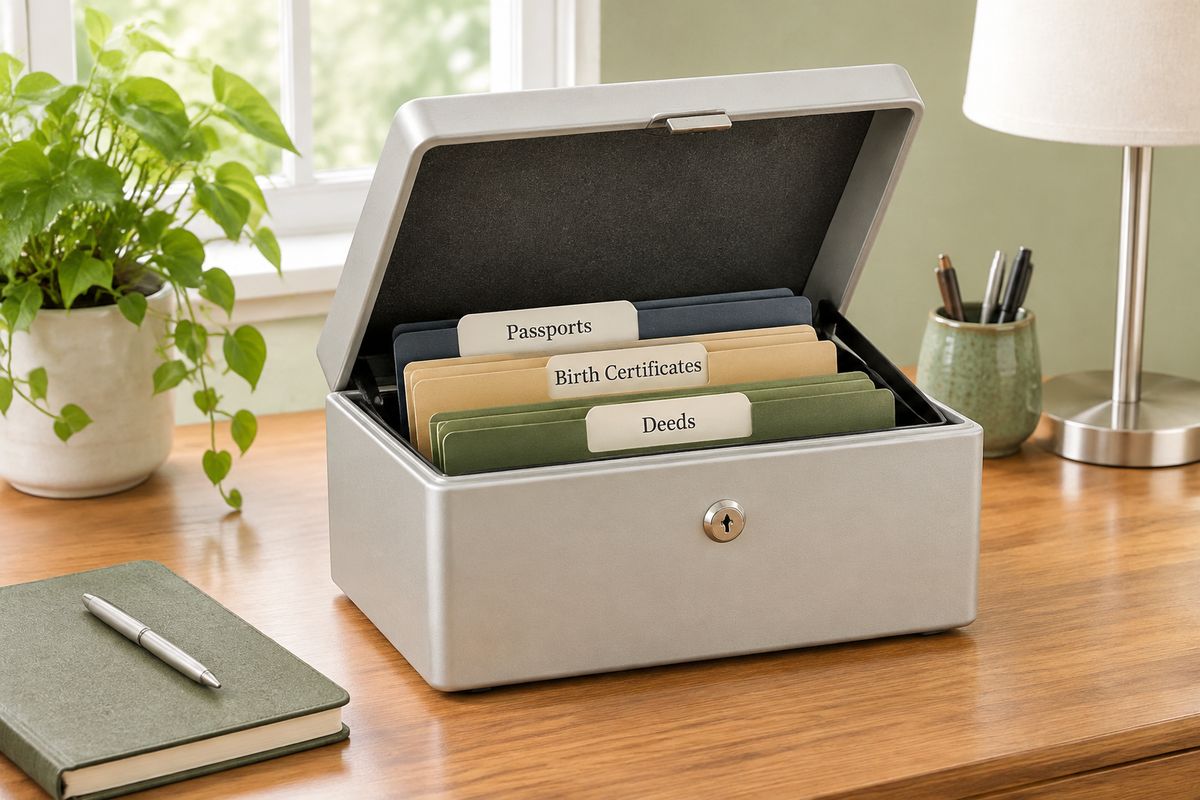
Store originals in a fireproof and waterproof document box or a safe deposit box, and keep scanned copies in an encrypted cloud folder. Tell one trusted person where they are.
8Set up a simple yearly purge
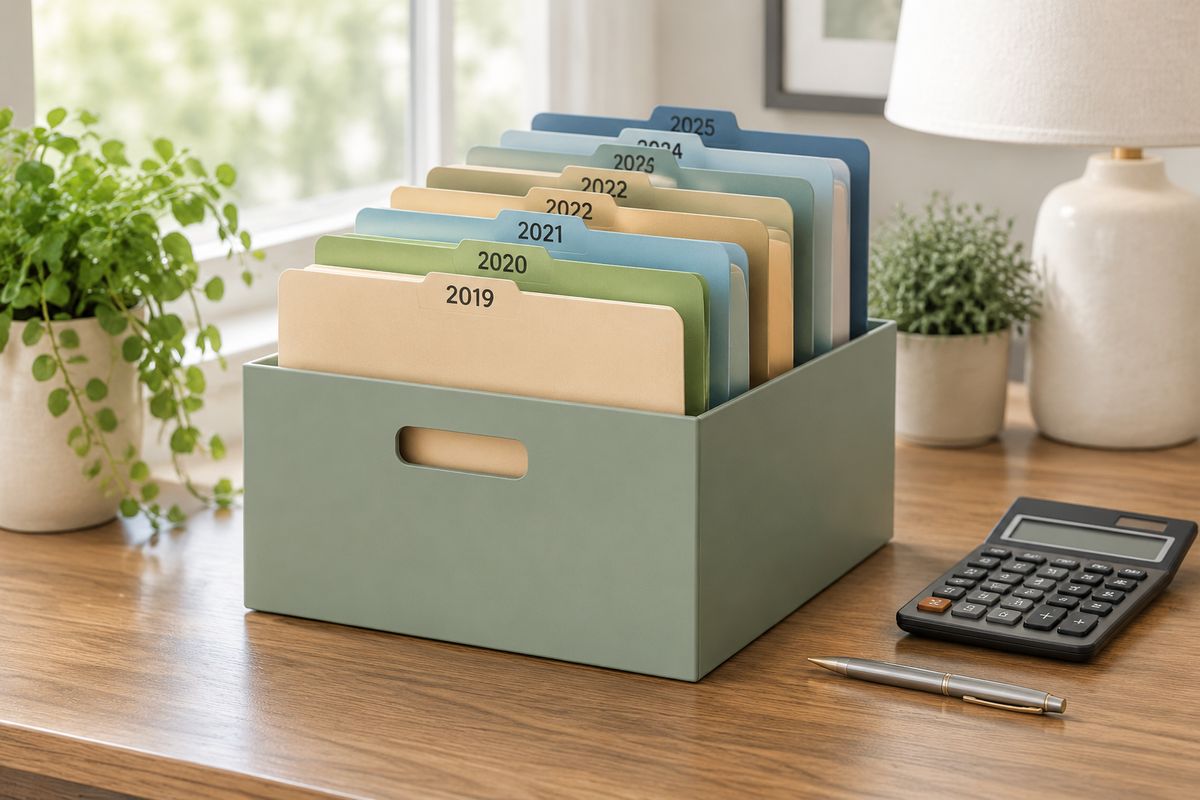
Once a year, ideally right after you file your taxes, pull the oldest tax year folder that is past your retention date and shred it, then start a new folder for the current year. Go through the bills and statements drawer at the same time.
Shred anything with your Social Security number, account numbers or signature; recycle the rest. Our declutter checklist by room includes a paper section you can tick off in the same session.
During the year, keep one inbox tray for new paper and one folder labeled with the current tax year. Anything that might matter for taxes goes straight into that folder, so next spring the paperwork is already in one place.

More documents and how long to keep them
| Document | Keep for |
|---|---|
| W-2 and 1099 forms | With the tax return, at least 3 years (many keep 7) |
| Annual retirement and brokerage statements | Until you close the account or retire; quarterly ones until the annual arrives |
| Car title and registration | As long as you own the car |
| Lease agreements | Until the lease ends and the deposit is returned |
| Paid-off loan letters | Long term, at least several years |
| Old insurance policies | Until replaced, unless a claim is open |
| Childcare and dependent care receipts | With the tax return for that year |
This chart is general information for US households, not tax or legal advice.
Going paperless without losing anything
Scanning is fine for most records; the IRS accepts electronic records as long as they are legible and complete. Scan to PDF, name files by year and topic (2026 Tax - Charity receipts), and back them up in two places, such as a cloud folder and an external drive.
Keep paper originals of anything official or hard to replace: vital records, deeds, titles, wills and powers of attorney. For a desk setup that keeps the incoming pile small, see home office organization ideas.
Keeping it that way
If you are clearing out a backlog, start with the easy wins: utility bills, old pay stubs that match a W-2, and bank statements more than a year old that do not support a tax item. That alone usually empties a drawer.
Then label one folder per tax year and one box for forever papers, and the pile stays manageable. Our free declutter checklist includes a printable paperwork page. For your own tax situation, especially if you run a business or had an unusual year, check with a tax professional.
Get the free Declutter Kit
A 7-page printable: room-by-room checklists, the 30-day challenge calendar and a 10-minute weekly reset. Free, straight to your inbox.
Everything mentioned in this guide
One list, so you can check sizes against your own measurements. Links go to Amazon; we may earn a commission.
Questions people ask
How many years of tax returns should I keep?
At least 3 years after filing for most people. Keep 6 years if you underreported income by more than 25 percent, and 7 years if you claimed a loss on worthless securities or a bad debt. Many people keep copies of the returns themselves permanently.
Is it safe to throw away tax records after 7 years?
For most households, yes, unless the records support property or investments you still own, or you did not file a return for that year. Keep property and basis records until a few years after you sell.
How long should I keep bank statements?
About one year for most statements. Keep any that support a tax deduction with that year's tax records. Most banks let you download older statements online.
How long should I keep pay stubs?
Until you receive your W-2 and confirm the totals match. Then shred the stubs and keep the W-2 with your tax return.
What documents should you keep forever?
Birth and death certificates, Social Security cards, passports, marriage and divorce papers, adoption and citizenship papers, military discharge papers, and wills, trusts and powers of attorney.
What is the best way to destroy old documents?
Use a cross-cut or micro-cut shredder for anything with personal or account numbers, or a community shred day. Recycle papers with no personal information.