How to Declutter Toys After Christmas (Without Tears)
To declutter toys after Christmas, gather every toy in one place, remove broken pieces and outgrown toys, then let each new gift replace one old one. Keep a small set out on shelves, pack the rest into a rotation bin, and donate clean, complete toys within a week so the decisions stick.
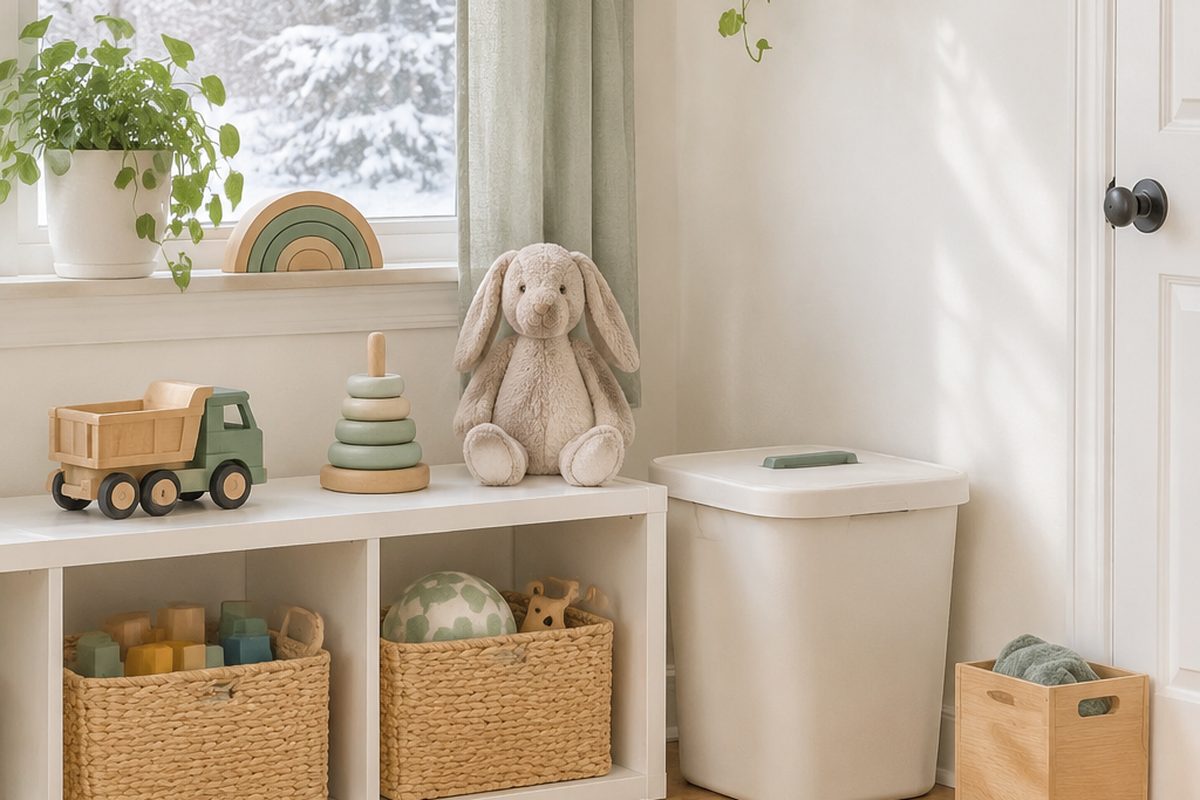
The week after Christmas, the toy situation usually looks like this: new gifts still in boxes, last year's favorites buried under them, and a playroom floor you cannot cross in socks. Kids have more than they can play with, and the extra stuff makes them play less, not more.
The fix is not a huge purge while the kids are at grandma's. It is a short, repeatable process: sort, swap, rotate and let go, with kids helping in a way that fits their age. If your space is tight, pair this guide with our toy storage ideas for small spaces once the toy count is down.
- Wait a few days, then gather everything
- Start with the easy cuts
- Use one in, one out for new gifts
- Set up a simple toy rotation
- Involve toddlers and preschoolers with small choices
- Let school-age kids decide with limits
- Give tweens ownership of their own space
- Give each category a home and a limit
- Get donations out of the house fast
- Plan a quick monthly reset
1Wait a few days, then gather everything
Give the new toys a few days of play before you start. You will learn which gifts actually get used and which ones were exciting for ten minutes. Then pick a calm morning, not a tired evening, and bring every toy from bedrooms, the living room and the car into one spot.
Seeing the whole collection at once is what makes decisions easy. Twelve toy cars look reasonable in a bin, but forty on the floor make the choice obvious. Set out four boxes or laundry baskets labeled keep, rotate, donate and trash, and have a bag ready for batteries and small parts that need a home.
2Start with the easy cuts
Before anyone gets emotional, clear out the toys nobody will miss. Broken toys, puzzles with missing pieces, dried-out markers, dead glow sticks, party favors and fast-food prizes go first. So do baby toys your youngest has clearly outgrown.
This step alone often fills a trash bag and a donation box, and it shrinks the pile enough that the harder decisions feel manageable. Test anything with batteries as you go. If a toy only needs new batteries, set it aside with a sticky note; if it still does not work, it goes. Match up loose pieces with their sets so you can tell what is actually complete.
3Use one in, one out for new gifts
One in, one out is the simplest rule for keeping toy numbers steady: each new toy that stays replaces one old toy that leaves. A new dollhouse can replace the old one. A new building set can replace a craft kit that never got opened.
Apply it by category rather than counting every item in the house. If a child got three new stuffed animals, three older ones go to donation or rotation. Explain the rule before the holidays next year so it feels normal rather than like a punishment. Older kids usually accept it best when they get to choose what leaves.
4Set up a simple toy rotation
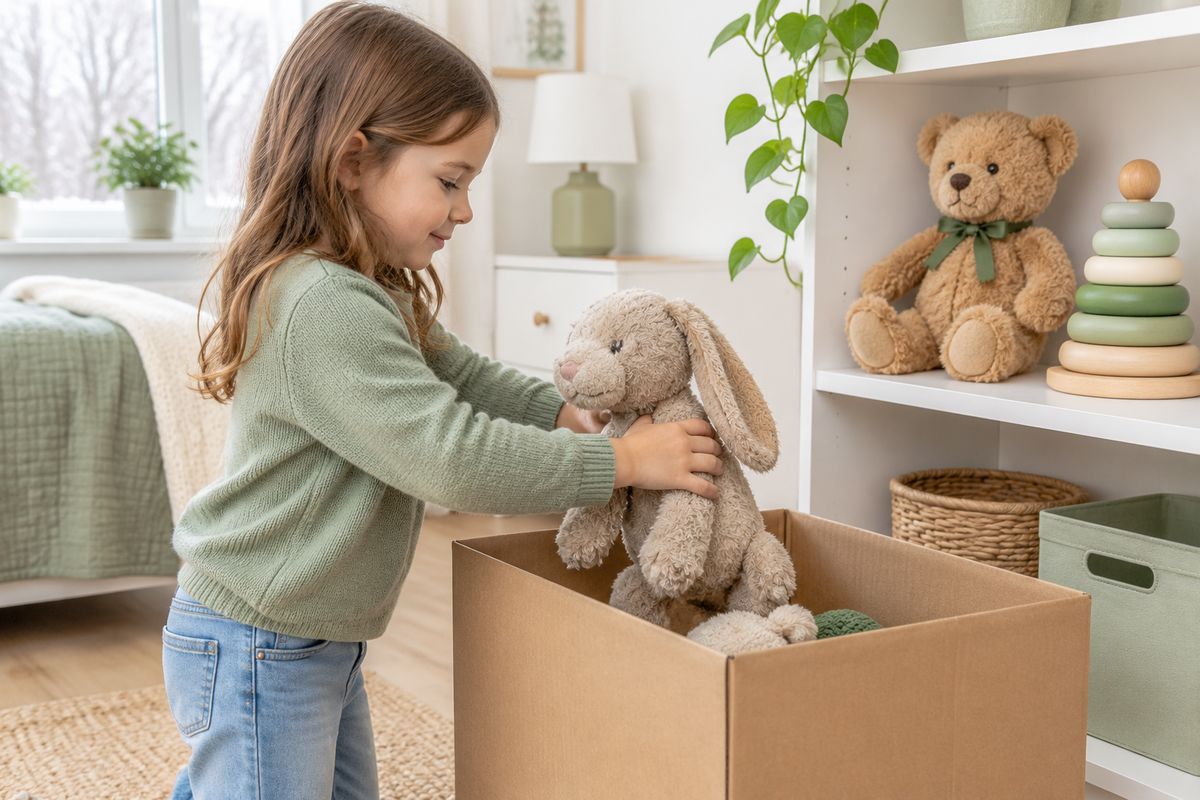
A toy rotation means only part of the collection is out at once and the rest waits in storage. When you swap bins every two to four weeks, the stored toys feel new again, and the play area stays easy to clean.
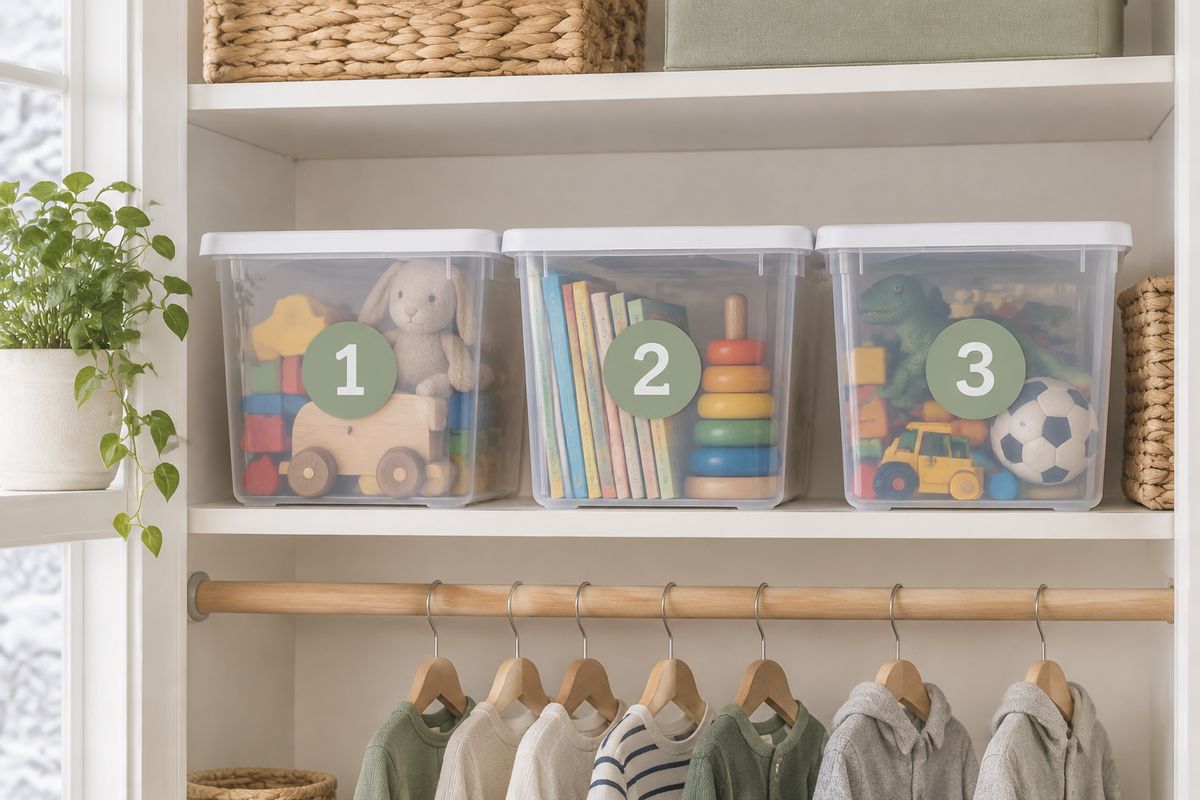
Split the keep pile into three or four mixed groups, each with something to build, something to pretend with, something active and a few books. Leave one group on the shelves and pack the others into lidded bins labeled 1, 2 and 3. Store them up high in a closet or under a bed, out of sight. If a child asks for a specific stored toy, swap it in; rotation should feel generous, not strict.
5Involve toddlers and preschoolers with small choices
Kids under about four are not ready to decide what leaves the house, and asking them to give up toys usually ends in tears. Do most of the sorting yourself while they are napping or out, and remove only toys they have not touched in weeks.
You can still involve them in a small way. Hold up two similar toys and ask which one they want to play with this week; the other goes into rotation rather than out the door. Let them carry the rotation bin to the closet. Keeping the decision about play, not loss, makes the whole process calmer.
6Let school-age kids decide with limits
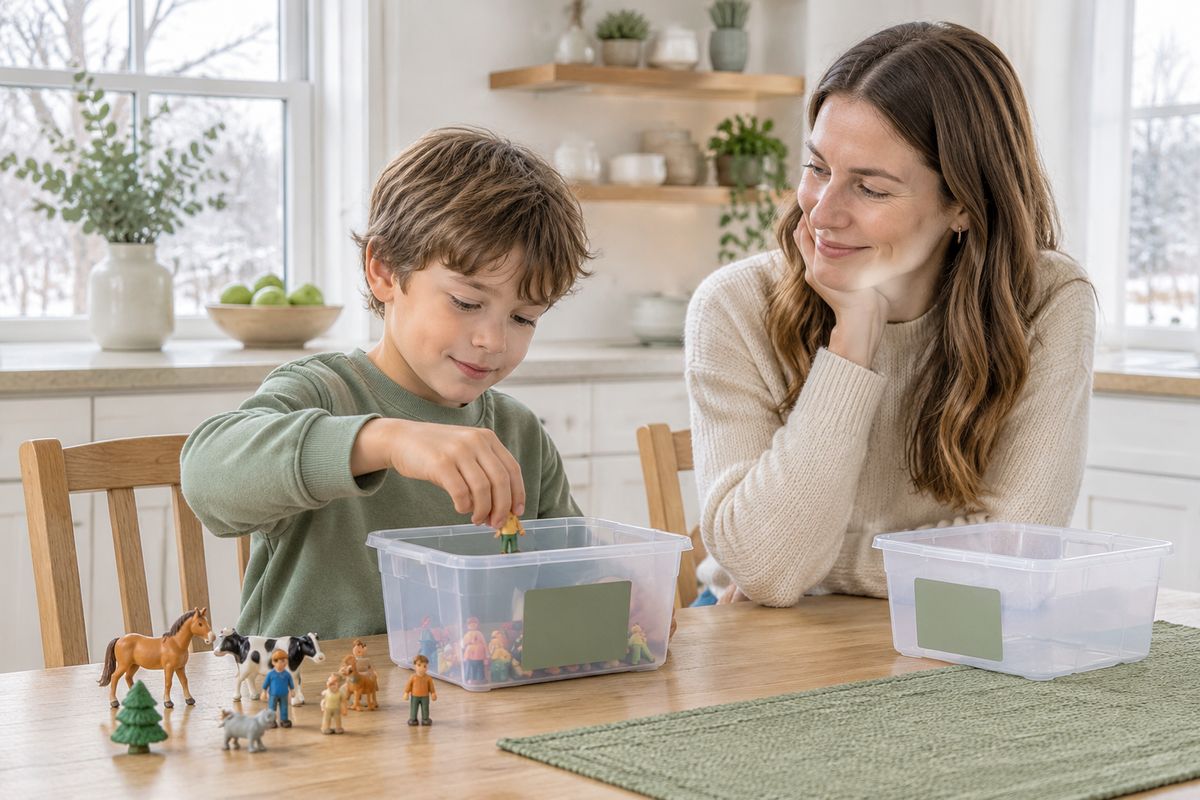
From around five to eight, kids can make real choices if you give them a clear frame. Use a container limit: all the action figures that fit in this bin can stay, and the child chooses which ones. The bin does the arguing for you.
Another approach is to ask them to pick a set number to share, such as five toys for another kid who needs some. Talk about where the toys will go, a shelter, a cousin or a classroom, so giving feels good. Praise the choice, not the amount, and never donate a toy they marked as special without asking first.
7Give tweens ownership of their own space
Kids from about nine up usually want control over their stuff, and they handle decluttering best when you step back. Ask them to go through their room or shelf on their own, with one rule: the floor and shelves need to be clear enough to clean.
Offer a reason that matters to them. Toys and games in good shape can be sold through a local marketplace or consignment shop, and tweens often get rid of more when they can put the money toward something they want. Check in at the end rather than hovering, and help them haul donations to the car.
8Give each category a home and a limit
Toys stay organized when every category has one container and a clear limit. Blocks get a bin, cars get a bin, art supplies get a caddy, and stuffed animals get one basket or hanging net. When the container is full, the category is full.
Use picture labels for kids who cannot read yet, so they can put things away without help. Keep containers open and light enough for a child to carry. Small parts sets like building bricks work best in a shallow bin or a play mat bag, so kids can see pieces without dumping everything. Measure the shelf before you buy anything with our storage bin size calculator.
9Get donations out of the house fast
A donation box that sits in the garage for three months tends to get unpacked by curious kids. Load it in the car the same day and drop it off within a week.
Thrift stores like Goodwill and The Salvation Army take most clean, complete toys. Local shelters, churches and preschools sometimes want toys too, but call first: many only accept new or gently used items, and children's hospitals usually take only new, unopened toys. Buy Nothing groups and neighborhood apps are a fast way to pass on big items. Do not donate cribs, car seats or toys with recalls; check cpsc.gov if you are unsure.
10Plan a quick monthly reset
Decluttering once after Christmas helps, but a short monthly reset keeps the toy count from creeping back by spring. On the same day you swap rotation bins, spend fifteen minutes pulling broken toys and anything that was ignored for the whole month.
Keep a small donation bag on a closet hook so outgrown toys have somewhere to go between resets. Birthdays work like a second Christmas, so repeat the one in, one out swap after each party. If the rest of the house needs the same treatment, our 30-day declutter challenge takes it one small zone at a time.
What to keep by age
These are rough guidelines for a typical rotation set, not hard rules. Kids develop at different speeds, and a well-loved older toy can stay as long as it gets played with.
| Age | Keep out on shelves | Usually ready to go |
|---|---|---|
| Under 1 | Soft books, stacking cups, a few rattles and teethers | Toys that are cracked, peeling or have loose parts |
| 1 to 2 | Chunky puzzles, push toys, shape sorters, board books | Infant gyms, bouncers and newborn rattles |
| 3 to 4 | Pretend play sets, large blocks, simple art supplies, picture books | Toddler push toys, chunky puzzles they finish in seconds |
| 5 to 7 | Building sets, board games, dress-up, early readers | Preschool sets with missing pieces, toddler books |
| 8 to 10 | Complex kits, chapter books, craft projects, sports gear | Picture books not saved as keepsakes, simple puzzles |
| 11 and up | Hobby supplies, strategy games, collections they care about | Younger toys they have not touched in months |
Follow the age label on toys with small parts, and keep them out of reach of children under 3.
Toys to keep, toys to let go
When you are stuck on a toy, these questions usually settle it in a few seconds.
- Has anyone played with it in the last month or two? If not, rotate it or donate it.
- Is it complete and working? Incomplete sets frustrate kids more than they help.
- Does it fit the child now, not the child from two years ago?
- Do you own several toys that do the same thing? Keep the favorite one or two.
- Is it a true keepsake? Save one small box of memories per child, not a whole closet.
Keeping it that way
Decluttering toys after Christmas works best in small steps: cut the obvious junk, swap old for new, rotate the rest and get donations out the door quickly. Kids learn the habit by doing it with you each year.
Once the toys are under control, keep going while the momentum lasts. Our guide to organizing your home in January picks up the rest of the house, and the free declutter checklist gives you a printable plan.
Get the free Declutter Kit
A 7-page printable: room-by-room checklists, the 30-day challenge calendar and a 10-minute weekly reset. Free, straight to your inbox.
Everything mentioned in this guide
One list, so you can check sizes against your own measurements. Links go to Amazon; we may earn a commission.
Questions people ask
How many toys should a child have out at once?
There is no magic number, but many families find that one shelf or about eight to twelve toys and a basket of books is enough for daily play. Store the rest in rotation bins and swap every few weeks.
Should I declutter toys without my kids knowing?
For toddlers and preschoolers, removing broken and ignored toys quietly is usually fine. School-age kids should help decide, and you should never give away a toy a child has called special without asking.
What should I do with gifts from relatives?
Keep the gift through the holiday season, then treat it like any other toy. If it does not get played with, rotate it first; if it still sits unused, it can be donated. Relatives gave it to make the child happy, not to fill a closet.
Where can I donate used toys?
Thrift stores such as Goodwill and The Salvation Army take most clean, complete toys. Shelters, churches and preschools may also accept them, but call first, because many only take new items. Children's hospitals generally accept only new, unopened toys.
How often should I rotate toys?
Every two to four weeks works for most families. Swap when kids seem bored or the play area keeps getting messy, and let a child request a stored favorite anytime.
How do I keep toys from piling up again?
Use one in, one out after birthdays and holidays, give each category one container, and spend fifteen minutes a month pulling broken or ignored toys. Small, regular resets beat a big purge each year.